
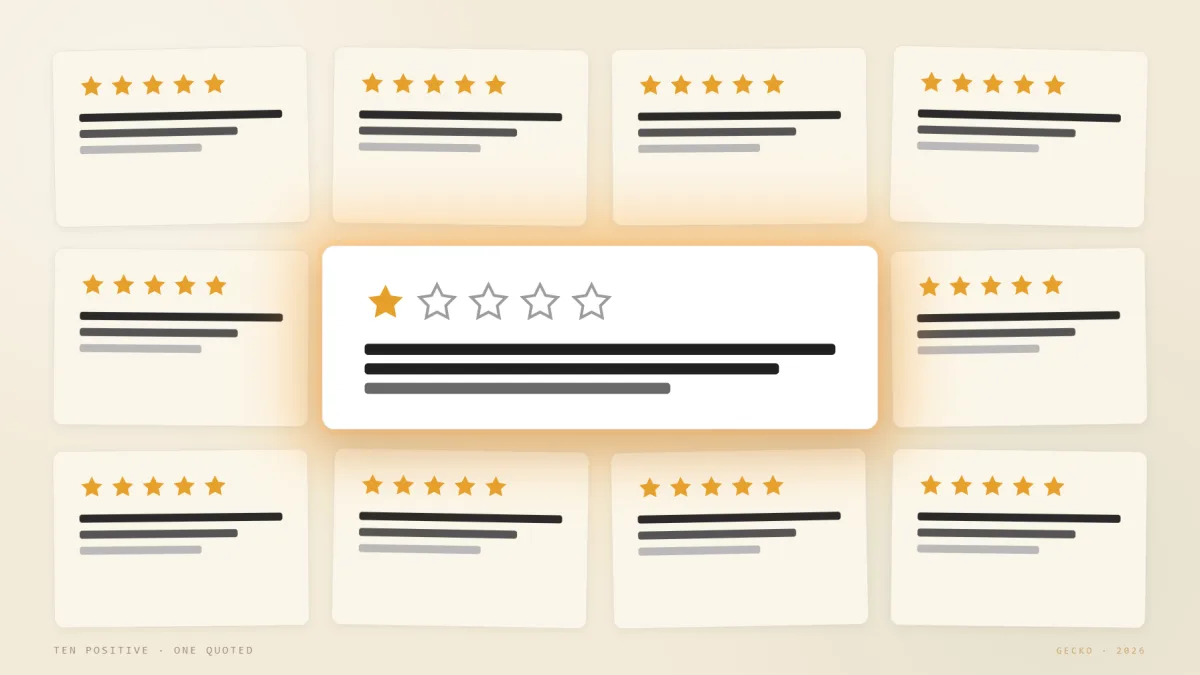
A client called us last week because their sector shows up in ChatGPT, yes — but the first sentence quoted a review of theirs from 2024. A 1-star review, written by a one-off customer, answered at the time and buried by 40 positive reviews afterwards. On their Google profile that review lives where it should: way down, sorted by relevance, almost invisible. In ChatGPT's reply it appeared as if it was from today.
This isn't a ChatGPT bug. It's the new logic. AI Overviews, AI Mode and the major language models don't sort your reviews by relevance or by date: they read them, pick one that "sounds interesting" and quote it verbatim. That changes something we've been assuming for decades — that a bad review gets buried by working your profile properly. It no longer gets buried. It gets quoted.
This article explains why it happens, what kind of review is most vulnerable, how to audit your brand in 5 minutes, and which three changes in your online presence (GBP and reviews) reduce the risk from the next time an LLM mentions your business.
Why a buried review surfaces again when an AI answers
Until recently, a 1-star review with a bitter narrative lived where you had filed it: in your Google profile, below the fold, sorted by Most relevant. If you had 40 good ones and replied to the bad ones, that review sank. The potential customer never reached it because they never scrolled. The system worked.
What's happening now is different. When a user asks ChatGPT, Claude, Gemini or Google's AI answer for "best [your sector] in [your area]", the model doesn't only look at Google rankings. It ingests reviews from Google, TripAdvisor, Booking, Trustpilot and vertical platforms. And when it builds its answer, it doesn't summarise the aggregate: it picks a concrete, quotable, eye-catching sentence and embeds it in its own reply. That sentence can be from six months ago or two years ago. The AI has no preference for recent.
The effect: an old, decontextualised review without your visible reply next to it can literally be the first sentence a potential customer reads about you, before they scroll anywhere.
Which reviews are most vulnerable
Not all reviews carry the same risk. The ones most likely to end up quoted by an AI share three patterns:
- They have narrative, not just stars. A review saying "the food arrived cold and the waiter ignored me" is more quotable than three words and an emoji.
- They mention your vertical or your area. A review naming the neighbourhood, the type of service or a specific dish fits better into geo-local search answers.
- They have no owner reply. When you respond with judgement, the AI has context: the review stops being read in isolation. When you don't respond, the sentence is left orphaned and quotable.
The operational consequence is clear: old bad reviews without a reply are now an exposure surface they weren't yesterday. That's why the first thing we recommend to clients with long review histories is going back to reply to the old ones, not just the latest month's.
How to audit in 5 minutes what each AI says about your brand
Before changing anything, measure. You need to know what each model quotes when a user asks about your sector. Do it with your brand and with your generic sector, and compare both answers.
Four prompts we apply in every AI-visibility audit at Gecko:
- "Best [your sector] in [your area] 2026" on ChatGPT, Claude, Gemini and Google with AI Mode active.
- "What do reviews of [your exact brand] say" — straight quote, no extra context.
- "Recommend a [your sector] in [your area] for [actual use case: romantic dinner, family trip, long-stay rental]".
- "Pros and cons of [your brand]" — force the model to look for the downside.
Capture the answers. Note which (literal) reviews each model is quoting. Compare against your Google profile and find the exact row. If a review from a year and a half ago appears quoted in ChatGPT and on your profile is replied to correctly, minor problem. If the review appears quoted and on your profile has NO reply, that's an urgency, not a maintenance task.
Three operational changes that reduce risk from the next ingestion
An AI doesn't update its corpus in real time, but it does update when it crawls your profile or the platforms it cites again. When that happens, we want it to pick up the right context. Three changes that do the job:
Reply to ALL negative reviews, including the old ones. A serious owner reply rewrites the context the AI absorbs. If the AI quotes the review, it now has your reply alongside and the reading shifts. Don't reply defensively: explain what happened, what was done, what's changed since. The AI prefers a closed narrative over an orphaned review.
Clean up categories and services in GBP. A profile with three categories mixing different verticals (for example, Real Estate Agency + Vacation Rental Agency + Property Management) confuses the AI and makes your business show up in searches that aren't yours, where your reviews carry less weight. A single correct primary category and two coherent secondary ones help the model place you where you belong. And inside each service (Group dinner, Weekly rental, Full-day charter), use the long description field: 300 characters per service that the AI reads as the business's own narrative, not as an outside review.
Anchor your narrative in the long business description and in Google Posts. Google removed the Community Q&A section in January 2026, so that door no longer exists for seeding proactive questions. The two doors that do exist and that the AI reads: the business description (750 characters where you fit in first person what you do, who for, with what specialty and what makes you different) and Google Posts published regularly (offers, news, events). When an AI builds a summary about your brand, those texts — written by you, complete, recent — outweigh a one-off customer review.
The profile from two years ago no longer cuts it
If you left your Google Business Profile as it was in 2024, today you're maintaining a version designed for a results page, not for an AI. The difference is operational. The results page rewarded average stars, distance and review count. The AI rewards coherent narrative, owner replies, clean categories and a well-written business description.
Same job, with up-to-date judgement, is worth twice as much.
If you run a business in Ibiza with active online reviews — car rental, hotel, restaurant, charter, villa, tourist retail — and you haven't reviewed in the last six months what ChatGPT and AI Overviews say about your brand, that audit is priority one this month. It's included in our full SEO audit (60 modules, dedicated AI-visibility phase): we deliver what each model quotes about you, where the unanswered sentences are, and a three-month operational plan so the next ingestion picks up the right context.