
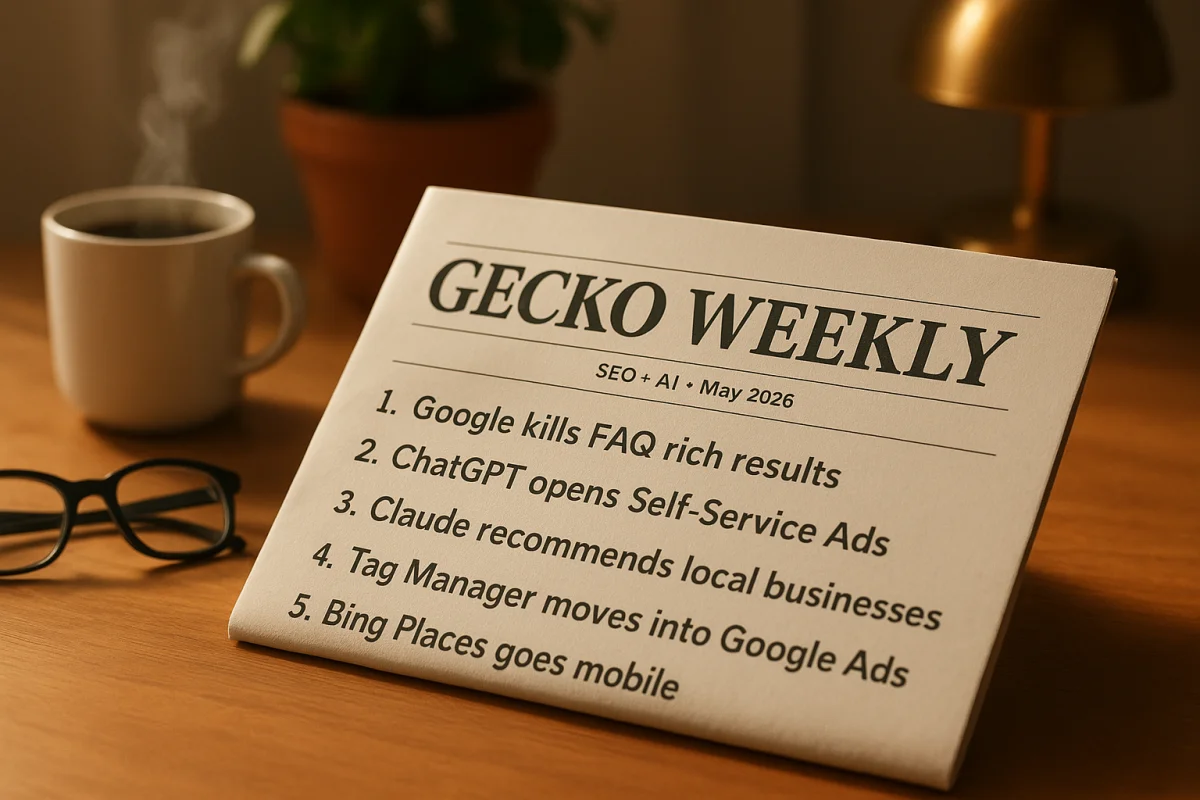
Between Monday May 5 and Sunday May 11, Google removed one type of rich result, ChatGPT opened its self-service ads manager, Anthropic gave Claude local-search recommendations, and Bing Places decided (in 2026) that mobile-responsive design was finally worth doing. Five changes in seven days. None of them catastrophic on its own, all of them relevant if your website depends on organic traffic or local conversion.
Here they are, with what to do about each.
Goodbye to FAQ rich results in Google Search and Search Console
On May 7, Google removed FAQ rich results from Search. Q&A blocks marked up with FAQPage schema no longer expand under the blue link. And in the coming weeks they will also disappear from the "Search appearance" report in Search Console.
If your CTR has dropped this week on URLs that depended on that expandable widget, now you know why.
Three concrete decisions:
- Don't strip the schema yet. Google still reads
FAQPagefor context, and more importantly, LLMs (ChatGPT, Claude, Perplexity, Gemini) use it when building cited answers. Removing it costs you twice: you lose a rich result that no longer exists, and you lose signal toward AI. - Audit which FAQ content was actually working. If a question resolved intent and brought clicks on its own, keep it on the page and tighten the answer to 2-3 lines (the format LLMs reuse verbatim).
- Measure the impact before doing anything structural. Compare CTR on URLs with
FAQPageschema for the week of April 28 vs the week of May 5. If the drop is <5%, leave it alone. If it's >15%, there's a case for rewriting the first 50 words.
Source: Search Engine Roundtable — Google Search Drops FAQ Rich Results
ChatGPT opens Self-Service Ads Manager: the next ad wave starts inside LLMs
OpenAI made its self-service ads manager publicly available, U.S.-only for now. Until last week, buying advertising on ChatGPT required going through a partner agency. Now any account holder can log in and run a campaign directly.
Why it matters even if you're not in the U.S.:
- The European rollout will be a matter of months, not years.
- An ad unit inside an LLM response doesn't compete with a classic Google ad. It competes for the answer itself — for what the model "decides" to say.
- If your sector has buyer personas who already ask ChatGPT before they Google (B2B SaaS, online education, professional services, technical verticals), it's worth preparing creatives designed for that format before it gets crowded.
Immediate action: none. 90-day action: identify 1-2 pilot campaigns that make sense for ChatGPT and have them ready to activate when Europe opens.
Source: Near Media — ChatGPT Ads, Claude Goes Local, AI Ranking Factors
Claude starts recommending local businesses: your GBP listing isn't only competing on Google Maps
Anthropic enabled local-business recommendations inside Claude's responses. When someone asks Claude for "the best mechanic near me", Claude now answers with concrete names.
This changes the local SEO game more than most Google algorithm updates of the past year. Until now, the "near me" battle was fought in Google Maps + the local pack + reviews. From now on it's also fought in how LLMs read your business when they construct their answer. It's a shift we started documenting in March: classic local SEO is no longer enough — you need an AEO layer on top.
Three levers worth reviewing on any Google Business Profile listing (yours first):
- Complete and correct
LocalBusinessschema. LLMs read this better than the narrative description inside Google Business Profile. - Reviews answered with context, not with "thanks for the rating". The replies feed the corpus the model cites.
- Consistent citations across sectoral directories. LLMs cross-check mentions, not just links.
The local-SEO playbook of "post once a month and forget" was already running on borrowed time. This shortens the runway.
Source: Near Media — Claude Goes Local
Google Tag Manager moves inside Google Ads: fewer tabs, new UX
Google is rolling out native Tag Manager integration inside the Google Ads interface. Tag management (conversions, audiences, events) will be doable from the Ads account without jumping over to tagmanager.google.com.
Good side: fewer open tabs, fewer mismatched account links, fewer "I don't know why the conversion isn't firing" tickets.
The bumpy side: the new UX changes flows that have been muscle memory for years. Whoever runs your account — in-house or agency — will take twice as long to set up a new conversion in the first two weeks while they relearn where everything lives.
If you have active campaigns right now, it's wiser to avoid structural changes until the rollout is complete in your account and the new interface stabilizes.
Source: Search Engine Roundtable — Google Tag Manager Coming to Google Ads
Bing Places is finally mobile-friendly (in 2026)
Microsoft announced that Bing Places for Business now offers a mobile-responsive experience. Yes, in 2026.
It matters because Bing is gaining organic traffic ever since ChatGPT started using it for live web browsing. The listing you keep in Bing Places now has real consequences: it feeds both the classic Bing result page and ChatGPT's browsing answers.
If you never bothered activating Bing Places because the back-end was unusable: that excuse is gone.
Source: Search Engine Roundtable — Bing Places For Business Finally Mobile Friendly
SEO and AI changes: what to do on your website this week
Boiled down to the actionable:
- If your website uses
FAQPageschema and relies on rich results: measure CTR pre/post May 7, decide on FAQ rewrites based on the data, not on reflex. - If you sell B2B or training: start sketching ChatGPT Ads creative even if you can't activate it in Europe yet.
- If you have a Google Business Profile (everyone does): review
LocalBusinessschema, the quality of your review replies, and citation consistency. Your business is starting to be recommended (or not) inside LLMs. - If you have active Google Ads: ask whoever runs your account to hold off on refactors until the new Tag Manager UI is stable.
- If you've left Bing Places dormant: turn it on. It's getting real traction now.
If you'd like us to review how these specific changes affect your site, we can do that in a quick audit.